
Hardwood floors are an investment, and the wrong cleaner can dull a finish, swell the boards, or leave a sticky film that attracts more dirt than it removes. A good hardwood floor cleaner does the opposite: it lifts grime, dries fast, and respects the finish underneath. With dozens of bottles lining the aisle at every big-box store, picking the right one isn’t always obvious. This guide breaks down what actually matters in 2026, from formulas and ingredients to finish compatibility and technique, so floors stay sharp for decades.
Table of Contents
ToggleKey Takeaways
- A good hardwood floor cleaner must have a near-neutral pH, evaporate quickly, and leave no haze or residue to protect your floor’s finish for decades.
- Match your cleaner to your floor’s finish type: use pH-neutral water-based cleaners for polyurethane finishes, solvent-based cleaners for waxed or oiled floors, and manufacturer-matched products for specialty finishes.
- Avoid ammonia, bleach, high-concentration vinegar, and wax-enhanced formulas on modern polyurethane finishes, as they cloud the topcoat or create buildup that interferes with recoating.
- Always spray the hardwood floor cleaner lightly onto a microfiber pad (never directly on the floor), work with the grain using long overlapping strokes, and follow with a dry pass to prevent water damage.
- Pair the right cleaner with good habits—regular vacuuming, walk-off mats at doors, proper humidity control (35–55%), and a topcoat refresh every 7–10 years—to keep floors sharp and durable.
What Makes a Hardwood Floor Cleaner Truly Effective
An effective hardwood floor cleaner does three things well: it dissolves common household soils (dust, oils, foot traffic residue), evaporates quickly without saturating the wood, and leaves no haze or buildup behind.
Water is hardwood’s natural enemy. Anything labeled as a wood floor cleaner should have a near-neutral pH (around 7) so it won’t etch a urethane finish or strip a wax coating. Strongly alkaline or acidic formulas, the kind found in general-purpose cleaners, can cloud the topcoat over time.
Quick evaporation matters just as much. Top rated hardwood floor cleaner formulas are designed to flash off in minutes, not soak between planks where they can swell the subfloor or warp engineered cores.
Types of Hardwood Floor Cleaners to Consider
Not every cleaner suits every situation. The category breaks down along two lines: the base chemistry and the delivery format.
Water-Based vs. Solvent-Based Formulas
Water-based cleaners dominate the market. They’re low-odor, easy to rinse, and safe for most polyurethane-sealed floors. They’re the right pick for routine weekly cleaning.
Solvent-based cleaners (sometimes called “dry” cleaners) use mineral-spirit-style carriers. They shine on waxed or oiled floors, lifting embedded grime without raising the grain. They’re flammable, so good ventilation and nitrile gloves are non-negotiable. According to expert cleaning recommendations, matching the carrier to the finish is the single biggest factor in avoiding long-term damage.
Sprays, Concentrates, and Ready-to-Use Mops
- Spray bottles: Best for spot cleaning and small rooms. Convenient but pricey per ounce.
- Concentrates: Diluted with water in a bucket or spray mop. Cheapest per square foot, ideal for whole-house cleaning.
- Ready-to-use mop systems (think pad-style applicators): Fast and tidy, but the pads add up. Great for households that clean frequently in short bursts.
Key Ingredients to Look For (and Ones to Avoid)
Reading the label tells most of the story. Helpful ingredients include:
- Mild surfactants (coco-glucoside, decyl glucoside) that lift soil without residue
- Chelating agents that bind hard-water minerals so they don’t leave streaks
- Low-VOC solvents that speed drying
Ingredients to walk away from:
- Ammonia, clouds urethane finishes
- Bleach, discolors wood and breaks down sealers
- Vinegar in high concentrations, acidic enough to dull polyurethane over time, even though its popularity in DIY recipes
- Pine oils and “wax-enhanced” formulas on modern poly finishes, they create a slick film that interferes with future recoating
For budget-minded readers, simple homemade floor cleaner recipes can work for sealed floors when the dilution is right. The risk with DIY is overdosing on acids or essential oils, so measurement matters.
How to Match a Cleaner to Your Floor’s Finish
Finish type drives the entire decision. Most floors installed after the mid-1990s wear a polyurethane (oil- or water-based) topcoat, but older homes may have penetrating oils, wax, shellac, or varnish.
A quick test: drip a few drops of water on a high-traffic area. If it beads, the floor is sealed (poly or varnish). If it soaks in and darkens the wood within a minute, it’s an oiled or waxed surface.
- Polyurethane finishes: Use a pH-neutral water-based wood floor cleaner. Avoid anything labeled “polish” unless a recoat is planned.
- Wax or shellac: Stick to solvent-based or buffable cleaners. Water-based formulas will leave white spots.
- Oiled (Rubio, Osmo, etc.): Use a manufacturer-matched soap. Generic cleaners strip the curing oil.
- Engineered hardwood: Treat it like the topcoat dictates, usually poly, but use less liquid since the veneer is thin.
Detailed finish-matching guidance is worth bookmarking before buying anything in bulk.
Best Practices for Cleaning Hardwood Floors Without Damage
Even the best hardwood floor cleaner won’t compensate for bad technique. Follow this routine:
- Dry-clean first. Vacuum with a hard-floor setting or use a microfiber dust mop. Grit is what scratches finishes, not foot traffic alone.
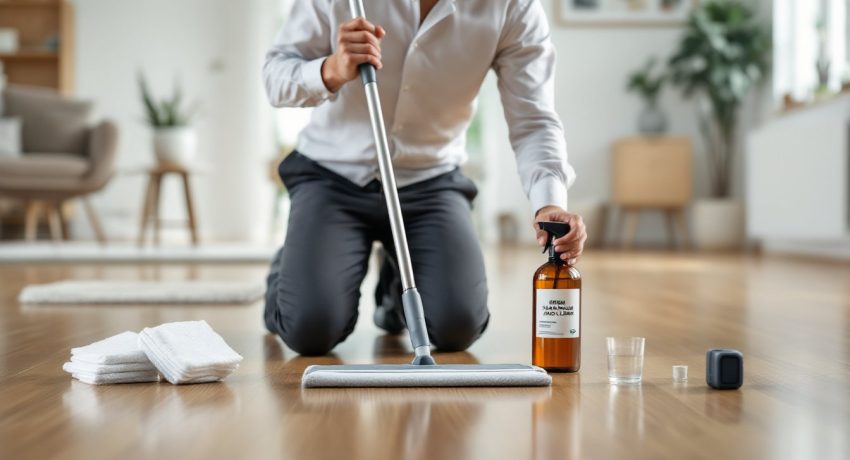
- Spray, don’t pour. Mist the cleaner lightly onto a microfiber pad, not directly on the floor. The pad should feel damp, never wet.
- Work with the grain. Long, overlapping strokes pull soil along the boards rather than pushing it into seams.
- Dry as you go. In humid rooms, follow with a dry microfiber pass.
- Spot-test new products. Try any unfamiliar cleaner in a closet corner for 24 hours before tackling the whole room.
A few extra habits stretch a floor’s lifespan considerably:
- Place felt pads under furniture legs and replace them yearly.
- Use walk-off mats at exterior doors to trap grit. Practical household routines from cleaning experts suggest a 4-by-6-foot mat catches roughly 80% of incoming debris.
- Keep indoor humidity between 35% and 55% to prevent gapping and cupping.
- Refresh the topcoat (screen and recoat) every 7–10 years instead of waiting for a full sand-and-refinish.
Safety-wise, when working with solvent cleaners or moving heavy furniture, safety glasses and gloves are smart. Knee pads help on bigger jobs.
Finally, a quick reality check: if a floor is already damaged, no cleaner will reverse cupping, deep scratches, or worn-through finish. Those call for a refinisher, not a bottle.
A good hardwood floor cleaner is less about the brand on the label and more about the match between formula, finish, and routine. Pick a pH-neutral water-based product for most modern floors, keep a microfiber mop within reach, and skip the miracle polishes. Floors that get this kind of steady, low-drama care often outlast the people who installed them.